Utilizing Telematics Data in Your Operation - LinkedIn Live Ep. 1
-
Hear from Raymond’s President and CEO Michael Field about the future of the industry as he announces a new Raymond intralogistics solutions initiative.
1. Why is utilizing telematics data important for our material handling organizations?
Jason Fiume:
"Intralogistics Solutions, as we define it, is the art and science of optimizing, integrating and automating both process flows and overall material flows within a warehouse or distribution center."
"There are a lot of moving parts, all of those things have to be brought together in the right order, at the right time. E-Commerce is an even bigger challenge now, relative to how do things work, where do they go, how do you get them there fastest, how do we make sure that they get all of the right items at the right time?"
"Those warehouses and distribution centers are constantly under pressure to improve shorter lead times, better delivery, and higher quality, so this end-to-end logistics and Intralogistics, as you mentioned, is important more important than ever."
"The people that can help those warehouse and distribution customers do this better, really are our valued supply partners at this point. This one-stop-shop approach both for E-Commerce as a customer, but also as the people who run those warehouse and distribution centers, are really valued. How do you connect the right technology? How do you make sure you have the right material handling equipment? How do you train your operators? How how does it all work together? To learn a little bit more we're gonna have a short video about how what Intralogistics is and what they can do for you"
2. With so many solutions available, how can customers find the right technologies to meet their needs?
Michael Field:
“The whole focus is around Optimize, Connect, and Automate. How do we make sure that we're taking the right steps with the equipment they have and what equipment do they need to add, or change, as time goes on? As you can see from the graphic you know we have many pieces of material handling equipment to choose from."
"We have lots of telematics and other technologies, labor management systems, picking solutions, location systems. All of those give you insights into what needs to happen within your warehouse and then you have tons of support services as well, and then finally you get to the automation piece."
"It's really this journey of optimizing your existing process, connecting all of these pieces of data to make you help you make better decisions and then automating those operations.”
“Raymond has a very long history of being in this business and we have three basic tenants around innovation, quality. and service, and that's our commitment to our customers."
"We're also a TICO Industries company, so we have a deep understanding of TPS and Lean Management and actually what we undertook was an approach to go from factory to field so all those things that we learned in the factory, we applied to our solution and support centers to make sure that they understood deeply how to optimize and improve and continuously Kaizan."
"Again, optimizing using lean management, understanding how that process works, what you should do with it, where to improve it. Then, take the data that you get from all of the different connected solutions around telematics, and labor management systems, and picking solutions, and location systems, and come up with better solutions than you had in the fully manual optimized approach, and then finally you're ready for the journey of automation."
3. How do you see Intralogistics Solutions evolving in the future?
Michael Field:
“The industry itself has gone through a dramatic shift with E-Commerce. The challenges of the pandemic have forced us to grow and improve at rates that we never thought possible before. All of the business models have kind of been turned on their ear and we need to find better ways, constantly, so again this flexibility is so important.”
“There are lots of new technologies that are coming out A.I. The next era of those technologies and how they affect human labor and how human labor gets to be better because of those technologies, not replaced by. There are real game-changers that are coming at us in what we're doing.”
“One of those areas is that shared autonomy. How do we connect a process, the technology that's in it, that may be robots with operators, such that they're doing things at rates and at capabilities and efficiencies they didn't think [were] possible before?
“The other side is e-learning, how do we train people? The new challenges and opportunities we have with things like virtual reality trainers, simulation tools, augmented reality, and the approaches that are available there and then finally taking all of those connected approaches that we have and looking at that from an A.I. standpoint. The artificial intelligence and deep learning that is available creates a very rich and robust picture for us in the future.”
4. What are technologies that Raymond provides to minimize the strain on employees and allow them to do their jobs more efficiently?
Jason Fiume:
“We're seeing a lot of customers having to do more with less. Dealing with a peak within a peak with a pandemic and labor considerations are a big part of that. We're also seeing that operations are struggling to hire train and retain associates in today's environment on top of that look at the low-level order picking adding some complexity there.”
“Not only is labor a large portion of our cost but picking is an extremely labor-intensive and costly activity. We had some studies that showed up to 55% of warehouse operating costs and 70% of their operating time can be attributed to the picking process, and this is where Raymond looks to have those Intralogistics Solutions available to help assist with that technology.”
“Our operator assist technologies can be added to the base layer of our trucks, and that's where that solution comes into play. One example is the Pick to Pallet LED Light System this is offered exclusively by Raymond and it uses LED technology to visually reinforce product placement in batch picking applications.”
“It basically improves fulfillment times, and most importantly, it enhances operator confidence in training. So the light indicates which customer palette to place the product on and that allows the associates to move quickly onto their next pick. We actually did see that we had a customer experience an estimated 20% productivity increase while also improving a 35% reduction in their pick error so that's very large gains for that operator assist technology.”
5. What are other types of picking solutions for different picking operations?
Jason Fiume:
“Order picking is not just low-level, we also see that it happens with our Orderpicker. A solution that can be added to the base layer of our 5000 series Orderpicker is what we're calling Raymond Zoning and Positioning, or ZAP. That technology helps ensure reliable, and again, repeatable forklift operation and it's all carrying that theme of instilling operator training and confidence.”
“So how does this work? It's an RFID tag that gets embedded in the floor of the warehouse and that helps transmit locations to your trucks and that enhances manual controls. Ultimately, we're reducing human error and it helps operators focus on the task at hand, so when it comes to that it's a matter of avoiding impacts with known obstacles within your warehouse. If you've got height restrictions or various areas where you want to control movement, the zoning and positioning really play into that.”
“One specific feature is the zoning and that's what limits trucks functions such as lift height and travel speed based on unique conditions. That might be varying ceiling heights truck restricted zones and allowing us to provide that opportunity to identify where those obstructions are. The RFID tags allow for customized zoning and understanding of where you are from a positioning standpoint, and that's the other part of this, positioning. Guiding the truck, and that operator, to the next storage location with the goal being taking the most efficient and optimal path, and as we mentioned before it takes the guesswork out a bit and allows those operators to focus on their surroundings.”
6. How to identify operations and their current and future technology needs?
Jason Fiume:
“I think a lot of this goes back to understanding what problem we're trying to solve. We focus a lot of our efforts, and the conversations that we have john, with asking customers questions about their operation before we just come in and introduce specific solutions. We look to position ourselves at, and what we look to make sure our customers are doing, is making sure that you're working with somebody who's going to partner with you to understand and allow you to be part of the solution and adding your voice to identify future state opportunities. A lot of those foundational efforts will really help us find the right solutions for you and empower you to create a culture of continuous improvement.”
“That's where the Raymond Lean Management principle comes in that Mike was talking about before. With techniques that basically allow you to standardize work, track KPIs, and make continuous improvements, it's one of those you can't improve what you don't measure scenarios. We're gathering and analyzing data, we can do assessments to identify and eliminate waste that could be in time and materials, optimize your operations, and some of those savings can be used to reinvest in these intralogistics solutions.”
7. How can tracking equipment throughout our warehouse optimize processes, and reduce overall operational cost?
Jason Fiume:
“Great question. I think a lot of that goes to again part of that visibility conversation we were having before, understanding where and how things are moving through your warehouse. That's where Raymond's Real-Time Location System (RTLS) comes into play. It's a tracking, locating, and monitoring system that allows you to restrict and control the movements of the trucks within user defined zones.”
“Most importantly you've got that bird's eye view of where those trucks are going within your warehouse. If you have passive congestion or high traffic areas we're able to identify that to help you create optimization of routes, processes, WMS transactions, to really start understanding the best flow of material through your warehouse."
"That high traffic component really allows us to identify potential misplaced products and reduces unproductive hours by some idle time that we have or unnecessary inactivity time that we're seeing through that RTLS component.”
“The additional component with RTLS is with that movement monitoring. We can control speeds and truck behavior within given zones as well to make sure that if there's an expected stop zone or “keep in, keep out” zone within your warehouse that we can make sure that the truck responds accordingly and we're protecting both our equipment and our people”
“When it comes to cost, we have our iTRACK fleet and asset management system. Essentially that allows us to provide service dispatch, acceptance, performance service and we can document all of that within the same portal as we do our other telematics solutions to really understand the cost of operating our equipment right. We can track and measure usage to cost to really get that cost per hour analysis for you.”
8. What solutions does Raymond have to meet the needs of avoidance type technologies?
Jason Fiume:
“With our telematics solution in general, we do have visibility into impact frequency severity, operators that might be having those incidents, but we're taking a little step further here with what we're calling iWAREHOUSE Object Sense. This is a flexible system that uses LiDAR sensors to basically help reinforce training.
"It goes back to that operator assist that we were talking about earlier and making operators aware of their surroundings, as it helps driving under certain parameters to avoid incidents. This solution is going to be available on our Orderpickers, Stand-Up Counterbalance, and Reach trucks, with additional models being added.”
“It allows you to reduce incidents, and how do we do that? A lot of it is through that LiDAR component that looks at dynamic detection zones, and those are going to adjust based on the truck speed and steer angle. Then when an object is detected in that travel path (this is when the trucks are traveling tractor first) the system will provide the operators with an audible and a visual alert, and it will try to slow that truck down to a controlled stop to eliminate the that impact incident from occurring”
You May Also Like:
Raymond Forklifts
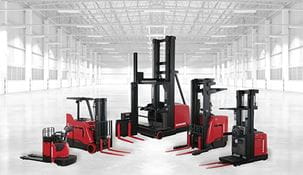
Raymond manufactures innovative electric lift trucks that deliver a lower total cost of ownership.
Learn More
Warehouse Products
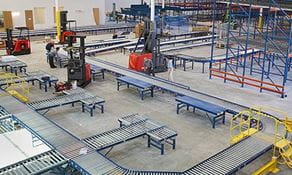
Learn more about the warehouse products offered by your local Raymond Solutions and Support Center.
Learn More
Warehouse Optimization Solutions
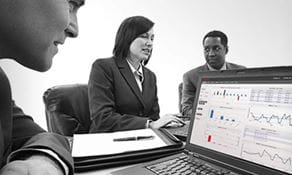
Manage smarter with fleet optimization, warehouse management systems and labor management solutions.
Learn More
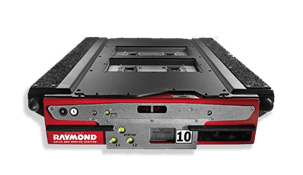
Automated Solutions
Let our experts evaluate your operation to determine if automated warehouse systems are right for you.
Learn More
