Identifying Intralogistics Solutions to Fit Your Operation
-
Hear from Raymond host, John Slavik, Senior Manager of iWarehouse Solutions, and special guest, Vice President of Customer Solutions and Support, Dave Norton, as they discuss how to identify intralogistic solutions to best fit your operation.
1. What are Intralogistics Solutions?
Dave Norton:
"We look at Intralogistics Solutions as all the tools and technologies available to help optimize your operation, from forklifts to professional services and everywhere in between. Raymond recognizes that every operation, every customer is unique and requires different solutions in order to optimize. Even different facilities within a customer base may have different opportunities and different ways to improve their overall profit proficiency and productivity. And this is one of the benefits of working with Raymond and our solutions and support center teams."
Time in Video: 1:07
Michael Field (Not Shown in Video):
"Intralogistics Solutions, as we define it, is the art and science of optimizing, integrating and automating both process flows and overall material flows within a warehouse or distribution center."
"There are a lot of moving parts, all of those things have to be brought together in the right order, at the right time. E-Commerce is an even bigger challenge now, relative to how do things work, where do they go, how do you get them there fastest, how do we make sure that they get all of the right items at the right time?"
2. What should companies be considering before Automation?
Dave Norton:
“Well, we like to suggest that everybody think about optimizing your operation and connecting and then automating. Jumping directly to automation is not always the best path forward and we'll talk more about that as we move along here.
"When you start off with an inefficient process and you automate it, you basically make an inefficient process slower and it might not even work. Then, you have to iterate the automation as you work your way toward optimizing it after you automate. It's much more effective to optimize a process or a flow before you automate it so you can make sure you drive cost savings into your process and you minimize the repetitive nature of change after you automate.
John Slavik:
“I think by spending extra time on that repetitive nature you're actually eating into your ROI [Return on Investment].
Time in Video: 1:56
3. When we're talking about this "Optimization Journey", what are solutions that Raymond can provide for our customers?
Dave Norton:
“We like to look at this as a multiple step process; we want to gather and analyze data, we want to visualize and use our Raymond Lean Management tools to improve process flow, utilizing that data, understanding where your efficiencies and inefficiencies are, and then setting up the facility for success later on for automation. Also, it's really important to talk about engaging your people with lean thinking, because your people are the ones who know where the inefficiencies occur. Starting there is a huge opportunity to improve your overall processes. However, if they're not able to, or willing to, share those improvements with your leadership team you're not going to get there. So also, remember you can check our previous live LinkedIn broadcast on our Raymond Lean Management process.”
Time in Video: 3:14
Download our Intralogistics Solutions Brochure
4. What are things we can do to optimize operators training and proficiency?
Dave Norton:
“As you know Raymond has our Safety on the Move operator training program, but over the last couple of years have also released our virtual reality training process and our virtual reality simulators. We really like the opportunity to be able to train the proficiency and efficiency of operators using VR, allowing our operators to learn the rules of the road. Making sure they're all operating the same way in their daily operation but, also, we can allow the operators to experience scenarios and situations that they might never be able to experience in a stationary place like they can on a virtual simulation. So, we can expose them to pedestrians, to other forklift traffic, to over-the-road truck-trailer interactions, and those types of things to really help that operator get comfortable or those operators get comfortable with their learning and be ready for the real life when they get on a truck that actually is moving."
"The other thing we like to think about is the “cool” factor, we really think that this is helping with retention and also attracting new employees. It also allows us to pre-screen operators to quickly determine whether an operator is going to be able to operate a forklift truck, be comfortable operating a forklift truck, and even in certain circumstances operate a forklift truck elevated. It gives a very realistic rendering of being elevated and operators really can determine whether they want to be working up high or not or become more comfortable working up high in a stationary position on the virtual reality system."
John Slavik:
“One of the things I’ve discovered from talking to the training departments is they like the idea that they can be training multiple people on the systems at the same time because they get that visual on the screen and it's portable so it's able to move from location to location. Even the other people watching are learning. So, if an operator is driving the truck and the instructor is explaining things or recommending things, the other students can be watching and learning so that when it's their turn they will become more proficient, quicker."
Time in Video: 4:15
5. How can organizations teach employees to continually look for optimization opportunities?
Dave Norton:
“One of the things we like to think about when we talk about lean and Raymond Lean Management is, the ideas to help optimize your process and your system really can come from your associates or your employees. They're the ones who see the inefficiencies, they see the challenges that they face every single day, and if management embraces the ideas or the frustrations of their employees those ideas can be incorporated to help solve problems. If we actually embrace those ideas, we call kaizens, we can quickly and efficiently continuously improve a given process or flow by improving not only the operator efficiency, but also morale."
Time in Video: 7:20
6. What are some of the solutions that help to identify optimization opportunities?
Dave Norton:
“So, we look at several different areas for opportunities to optimize and connect. Our first area is through our iTRACK fleet system, where we can actually track all of the materials, services, maintenance costs, dispatching, all the reports of service information, consolidate that data, and, obviously, consolidate billing and invoicing to a customer. That gives us all the baseline of what the total cost of ownership is coming from and what the cost drivers are. After we look at all of the maintenance related type costs through iTrack, we move into telematics."
"Telematics, we can think of that easily, it's like a Fitbit or it's like an Apple Watch. That system is monitoring all the key parameters of the truck and gives us data on utilization of the truck, how's it being used, is it traveling, is it lifting, how much is it lifting, what percent of the time are we utilizing that piece of equipment. Often with that data we can determine that a very expensive truck, that's meant for lifting loads, is being used for mostly travel, where we could be using a different piece of equipment for the travel. We also can quickly identify inefficiencies within operations and the utilization of the equipment. Maybe you have more equipment that you need or maybe you don’t have enough of a given type of equipment because it's utilized at 100 percent. So those are the types of things we can learn from telematics."
"We combine telematics with iTrack, then we can really bring the data to life with your cost drivers, your total cost of ownership, and different opportunities to be able to improve the overall efficiency of your operation. Bring that together with the labor management system, we can collect and analyze data on what employees are doing from when they show up to work, until they go home at the end of the day. So, we bring together that very large cost driver of the overall operation, which is your employees, making sure that we're maximizing the efficiency and effectiveness of the employees, the equipment, and obviously driving the overall cost of ownership down."
John Slavik:
"I think one of the greatest things about these is that these products work incredibly well together, and they can be fully integrated, but they can be bought individually as well. So, if you just want to start with iTrack because you're looking for cost Information you can start there and then gradually move to telematics and then eventually to LMS, it's all available for you."
Time in Video: 8:20
7. What are some of the operator assist technologies that Raymond offers?
Dave Norton:
“One of the large challenges that we have and that everyone has right now is hiring people and retaining people, so we're continuously working on improving our products by creating operator assist technologies to help not only with training but also with improving proficiency and productivity of our customers’ operators. One of those products is our zoning and positioning products these are for very narrow aisle equipment both swing reaches and order pickers. They basically automatically take the vehicle from one pick location to another. So, in wire guided applications, it ensures that an operator is at the right pick face, and they can most efficiently and effectively pick that product and also get from point a to point b in the most efficient and effective way. It drives for very good repeatability and, obviously, allows the operators to spend more time picking and less time trying to figure out where to be for the next pick face."
Download our Real-Time Location System Brochure
John Slavik:
“Yeah, so it takes out that decision making that they have to do."
Dave Norton:
“Also, we have our Pick2Pallet system for floor level picking first and second level picking. With the great expansion we have in e-commerce, there’s a lot of strain on driving order picking, everybody's picking every day, we're getting products delivered to our houses, as we requested and most of the time it’s in a pretty quick time frame. So, order picking both with very narrow aisle, elevated, and picking from the floor is booming. With this process we actually have an LED lighting system that's mounted underneath the forks of the truck so that an operator can pick to two orders at the same time and minimize or eliminate the chances of putting the wrong order on the wrong pallet. This greatly reduces your pick errors and basically makes sure that an operator knows which pallet whether it's a, b, or c, that should be put on. Reducing pick errors, saves money all the way through because you're not having to re-pick and re-order those products because we missed the order.
Download our Pick2Pallet Product Information Guide
Lastly, we have our Raymond advance system, which will allow helping the operators in an aisle with more efficient picking and picking process
John Slavik:
“The other thing about the Pick2Pallet system that's great is, how quickly we can train our operators to start picking accurately. I think it reduces that training time because there's a visual indicator so it's a lot easier for them to understand exactly where they need to be picking too absolutely very good training aid as well.
Time in Video: 11:57
8. Why Automate?
Dave Norton:
“As we already discussed, automation is the end-all be-all. The challenge we have is, we often have a lot of customers come to us and say, “Hey my boss says I need to automate, where do I start?” That's where we really think walking the path that we've described throughout this conversation is key. Making sure that we understand what it is we want to automate; we want to automate repetitive tasks, that are the same thing over and over and over again, so that we can minimize those repetitive tasks, get those operators/associates to a job that's more complicated, something that, obviously, is less mundane and they can continue to grow and help support your business. That's the first step, knowing what you want to automate, how you want to automate it, and to know we're here to help with our solutions and support centers and our automation teams.”
"We want to reduce labor and we want to improve your overall efficiency, that's what everybody's looking for, and of course we want an ROI (Return on Investment). We're here to help and support. We have products to help you. Between our automated stackers, our tow tractors, and our pallet trucks, we have the capability of picking up and dropping off onto conveyors and into shelves, we have the tow tractor capability of pulling carts and trailer loads up to 15,000 pounds capacity. Then, we have the pallet trucks with transporting pallets over long hauls for put-aways, cross stocks, and to load staging applications.”
John Slavik:
“I’ve had a lot of experience with our courier line and I can tell you the ease of installation and implementation of these products is actually pretty impressive. How within just a couple of days we can have the customer themselves comfortable riding around on these trucks and training them on the routes that they need to train others on, so not relying so heavily on us but they can actually take ownership of their own product.”
Time in Video: 16:45
You May Also Like:
Raymond Forklifts
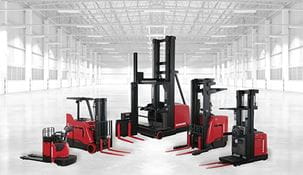
Raymond manufactures innovative electric lift trucks that deliver a lower total cost of ownership.
Learn More
Warehouse Products
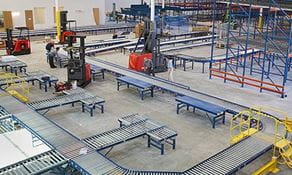
Learn more about the warehouse products offered by your local Raymond Solutions and Support Center.
Learn More
Warehouse Optimization Solutions
Manage smarter with fleet optimization, warehouse management systems and labor management solutions.
Learn More
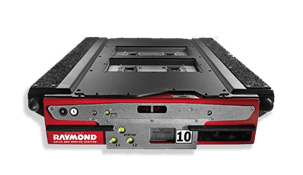
Automated Solutions
Let our experts evaluate your operation to determine if automated warehouse systems are right for you.
Learn More
